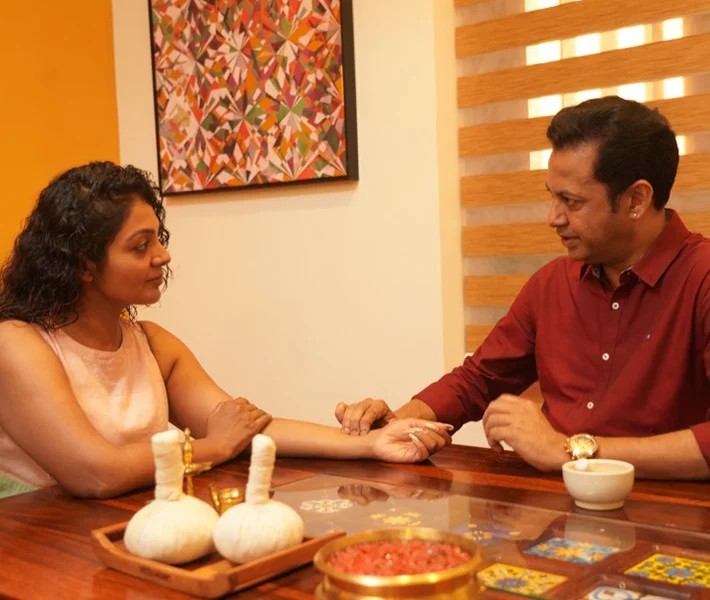
Behind every healing story is a Doctor who listens, understands, and cares. Our Ayurveda specialists bring individuality, yet share a single purpose: Your Complete Healing & Wellbeing.
Ayurveda, the millennia-old science, offers the quintessential holistic approach to health and emphasizes the uniqueness of an individual. Hence, it takes an experienced physician with exceptional diagnostic skills and in-depth knowledge to personalize and customize Ayurveda treatments, Ayurvedic medicines, and therapies to suit individual needs.
Ardently committed to Suddha Chikitsa (minimal side effects), the most-awarded and well-accomplished; Dr. Shyam’s sole objective is to “improve the patient’s health and provide a permanent cure” wherever possible. A proper diagnosis in terms of body type (prakruty) and imbalance (vikruty) is important prior to an Ayurveda treatment. In Ayurveda, a disease is examined by assessing five components:
The Ayurveda treatment approach and medicines of a disease may vary from person to person as Ayurveda says every individual is unique. Ayurveda treats the person who has a particular disease pathology; therefore, assessment of the diseased person is important in the healing process. The art of patient examination through 1) interrogation 2) inspection, 3) palpation (including pulse diagnosis) procedures; does not merely identify the symptoms of a disease but it is designed to find out the root cause of the symtoms. Ayurveda gives equal importance to assess the general health of the patient as the prevention of disease is equally essential to curing them. In a consultation process our Ayurveda doctor tries to assess:

Sara means the quality of body tissues. Assessment of Sara in Ayurveda is a tool to understand the health of body structure or a tissue. In a disease process, the functional impairment (explained as Vata, Pitta & Kapha imbalance) manifests in a weak body tissue. Therefore, by understanding one’s Sara, we may be able to forecast a disease onset and can take preventive measures.
Prakruti means nature or the innate body type. Vata, Pitta and Kapha is there in all of us performing different body & mental functions. However, we are different from each other in terms of appearance, behavior, emotions, pulse rate, heart beat, body temperature, likes etc. Ayurveda categorizes human body primarily into 7 types based on the dominance of dosha proportion which we receive from our parents – Vata type, Pitta type, Kapha type, Vata Pitta type, Vata Kapha type, Pitta Kapha type, Vata Pitta Kapha type. Therefore an awareness of self (body type) helps us to choose the most suitable lifestyle, food, herbs and medicines, treatments, oils and even the right career. It is however difficult to evaluate the body type of a person while he or she is suffering with an imbalance or disease.
: Vikruti means imbalance (opposite of Prakruti). Through pulse diagnosis, inspection and discussion with the patient, our Ayurvedic doctor analyzes the root cause of the problem and explains them as Vata imbalance or Pitta imbalance or Kapha imbalance. Our physicians also makes use of the modern investigating tools like laboratory tests of blood, urine, stool; X-Rays, MRIs, Ultrasound scanning etc for a diagnosis.
Once we make a diagnosis, our Ayurveda doctor shall suggest you the following to balance the Vikruti (imbalance of Vata, Pitta & Kapha):
Once we make a diagnosis, our Ayurveda doctor shall suggest you the following to balance the Vikruti (imbalance of Vata, Pitta & Kapha):